Unlocking Creative Potential with Deco Letters: A Guide to Laser-Cut Typography
In the evolving landscape of graphic design and digital fabrication, typography has transcended its traditional role as a mere vehicle for text. It has become a structural element, a decorative feature, and a primary component of physical art. At the intersection of digital aesthetics and tangible creation lies a unique resource known as Deco Letters. This specialized font family distinguishes itself by integrating intricate laser cutting patterns directly into the glyph designs, offering a seamless bridge between screen-based concepts and machine-ready files. For professionals, hobbyists, and business owners alike, understanding the utility of this tool is essential for maximizing efficiency in projects ranging from personalized signage to complex architectural installations.
The Fusion of Aesthetics and Functionality
Traditional fonts are designed primarily for legibility on paper or screens. They prioritize stroke weight, kerning, and x-height to ensure the reader can absorb information quickly. However, when text is intended to be cut from wood, acrylic, metal, or cardboard using a laser cutter, the requirements shift dramatically. The design must account for material integrity, bridge points to prevent inner pieces from falling out, and aesthetic flair that justifies the manufacturing effort.
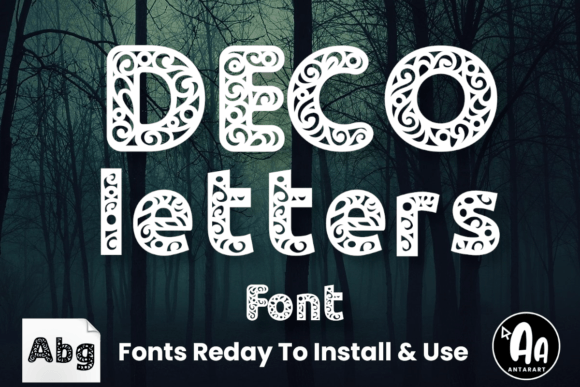
Deco Letters addresses these specific needs by embedding laser cutting patterns within both lowercase and uppercase characters. Unlike standard typefaces that require a designer to manually vectorize patterns or add cutouts post-production, this resource comes pre-engineered. Every letter acts as a self-contained template, featuring elegant internal geometries that mimic Art Deco motifs, filigree, and modern lattice structures. This fusion allows creators to bypass the tedious process of pattern application, moving straight from concept to production.
The elegance of the font lies in its versatility. While the term "Deco" might suggest a strict adherence to 1920s styling, the application of these patterns is broad. The geometric precision required for laser cutting naturally lends itself to clean, sharp lines that complement contemporary minimalism just as well as vintage ornamentation. Whether used for a wedding invitation suite cut from heavy cardstock or a large-scale billboard made from weather-resistant polymers, the visual impact remains consistent and high-quality.
Streamlining the Workflow for Digital Fabrication
One of the most significant advantages of utilizing a dedicated resource like Deco Letters is the optimization of the design-to-fabrication workflow. In a typical scenario involving custom typography for laser cutting, a designer would select a standard font, convert it to outlines, and then spend hours drawing internal cut paths. This process is not only time-consuming but also prone to errors. If a bridge is too thin, the material may break during cutting; if a hole is too small, slag may accumulate, ruining the finish.
By leveraging a font where the patterns are intrinsic to the character design, these risks are mitigated. The vectors are pre-calculated to maintain structural stability while achieving maximum visual permeability. This is particularly valuable for educators and researchers who teach digital fabrication. Instead of spending class time troubleshooting vector errors, instructors can focus on the principles of material science, machine operation, and creative composition. Students can experiment with different names and logos, instantly visualizing how the laser will interact with the material.
Furthermore, the scalability of these vector files ensures that the quality remains pristine regardless of the output size. A logo generated for a small jewelry tag retains the same crisp definition when enlarged for a storefront billboard. This scalability is crucial for businesses looking to maintain brand consistency across various physical touchpoints without incurring additional design costs for each scale iteration.
Material Considerations and Pattern Density
While the font provides the design, the success of the final product heavily depends on the choice of material. The intricate patterns found in Deco Letters interact differently with various substrates. For instance, when cutting plywood or MDF, the organic grain of the wood can enhance the visual depth of the cutouts, creating a play of light and shadow that adds a tactile dimension to the piece. Conversely, when using acrylic or glass, the transparency allows the background to show through the negative space, making the pattern itself the focal point.
Designers must consider the density of the laser cutting patterns relative to the material thickness. Thicker materials generally require wider bridges and larger cutout areas to prevent warping or burning. The variety of glyphs available in this font family often includes variations in pattern density, allowing users to select the appropriate style for their specific medium. A delicate, high-frequency pattern might be perfect for thin paper or veneer but could compromise the structural integrity of a thick steel plate. Understanding these nuances is key to professional execution.
Diverse Applications Across Industries
The utility of decorated names and logos generated through this technology extends far beyond simple signage. The ability to rapidly produce customized, patterned text opens up avenues for innovation in several sectors.
- Retail and Branding: Businesses can create distinctive window displays and interior decor that reflect their brand identity. A boutique hotel might use Deco Letters to craft room numbers that serve as art pieces, while a coffee shop could employ them for menu boards that double as textured wall features.
- Event Planning and Weddings: The demand for personalized decor is at an all-time high. From table numbers to elaborate backdrops for photo booths, laser-cut typography offers a level of customization that printed vinyl cannot match. The interplay of light through the cut patterns creates a romantic and sophisticated ambiance ideal for celebrations.
- Educational Tools: In STEM environments, these fonts can be used to create tactile learning aids. Letters with internal geometric patterns can help demonstrate concepts of symmetry, tessellation, and structural engineering to students in a hands-on manner.
- Architectural Elements: Architects and interior designers are increasingly incorporating typographic elements into building facades and partitions. Using laser-cut metal sheets with decorative lettering can provide privacy screening while allowing airflow and light penetration, serving both functional and aesthetic purposes.
Enhancing Logos and Corporate Identity
In the realm of corporate identity, a logo is more than a symbol; it is the face of the company. Integrating laser cutting patterns into a logotype can elevate a brand's perception, suggesting attention to detail and a commitment to quality. When a company uses Deco Letters to generate its physical signage, the result is a three-dimensional object that commands attention. The shadows cast by the cut patterns change throughout the day as the sun moves, giving the logo a dynamic quality that flat printing lacks.
Moreover, this approach supports sustainability initiatives. By cutting directly into the material rather than applying layers of ink or adhesive vinyl, businesses reduce waste and chemical usage. The longevity of laser-etched or cut designs also means that signage does not need to be replaced as frequently due to fading or peeling, offering a better return on investment over time.
Technical Implementation and Best Practices
To fully harness the potential of Deco Letters, users must be proficient in the software ecosystems that support vector graphics. Programs such as Adobe Illustrator, CorelDRAW, or open-source alternatives like Inkscape are standard tools for manipulating these fonts. Once the text is typed and converted to outlines, it is ready for import into laser cutting software like LightBurn or RDWorks.
It is critical to verify the line weights and color coding within the cutting software. Different colors often correspond to different machine actions, such as cutting, engraving, or scoring. Since Deco Letters relies on precise cut paths, ensuring that the software interprets the internal patterns as "cut" lines rather than "engrave" lines is vital. Misconfiguration here could result in a solid block of text with surface etching rather than the intended see-through pattern.
Additionally, testing is an indispensable part of the process. Before committing to a final, expensive material, it is advisable to run a test cut on a scrap piece of similar thickness. This allows the operator to fine-tune the laser's power and speed settings. Factors such as the focal length of the lens and the assist gas pressure (if using metal) can significantly affect the edge quality of the intricate patterns. A clean cut ensures that the delicate bridges within the letters do not snap off during handling.
The Future of Decorative Typography
As laser cutting technology becomes more accessible and affordable, the barrier to entry for creating complex, customized physical objects continues to lower. Resources like Deco Letters are at the forefront of this democratization, empowering individuals without advanced CAD skills to produce professional-grade results. The trend suggests a move towards hyper-personalization, where mass-produced items are replaced by bespoke creations tailored to individual tastes.
We are also seeing a convergence of digital and physical realms. Designers are beginning to simulate how these laser-cut fonts will look in augmented reality (AR) before a single cut is made. This allows clients to visualize a billboard or a logo in its actual environment, adjusting the scale and pattern density in real-time. The integration of such fonts into broader design workflows signifies a maturing industry where the distinction between graphic design and industrial design is increasingly blurred.
Ultimately, the value of Deco Letters lies in its ability to inspire. By removing the technical hurdles associated with pattern generation, it frees the creator to focus on the artistic vision. Whether crafting a delicate name tag for a gift or constructing a massive installation for a public square, the elegance and precision of laser-cut patterns offer a timeless appeal. As creators continue to push the boundaries of what is possible with light and matter, tools that facilitate this exploration will remain indispensable assets in the modern toolkit.
In conclusion, the adoption of specialized typography resources transforms the way we approach physical design. It encourages experimentation, reduces production time, and elevates the aesthetic standard of fabricated goods. For anyone involved in the creation of visual content, from the classroom to the boardroom, mastering the use of these decorative fonts is a strategic advantage in a competitive, visually driven world.